The Tiles
A Filipino Mahjong set has 144 tiles split into two groups. The three suited suits (Bamboo, Character, and Dot) are the tiles used to form melds and win the game. Bonus tiles (Winds, Dragons, Plants, and Seasons) are set aside at the start of each round and never used in melds, but each one you collect adds bonus points to your payout when you win.
Suited Tiles
Bamboo竹36 tiles(Also called Sticks)








Character萬36 tiles









Dot餅36 tiles(Also called Circles or Balls)









Bonus Tiles (Also known as Flowers)
Winds16 tiles




Dragons12 tiles



Plants4 tiles




Seasons4 tiles




Set-up
Build the Wall
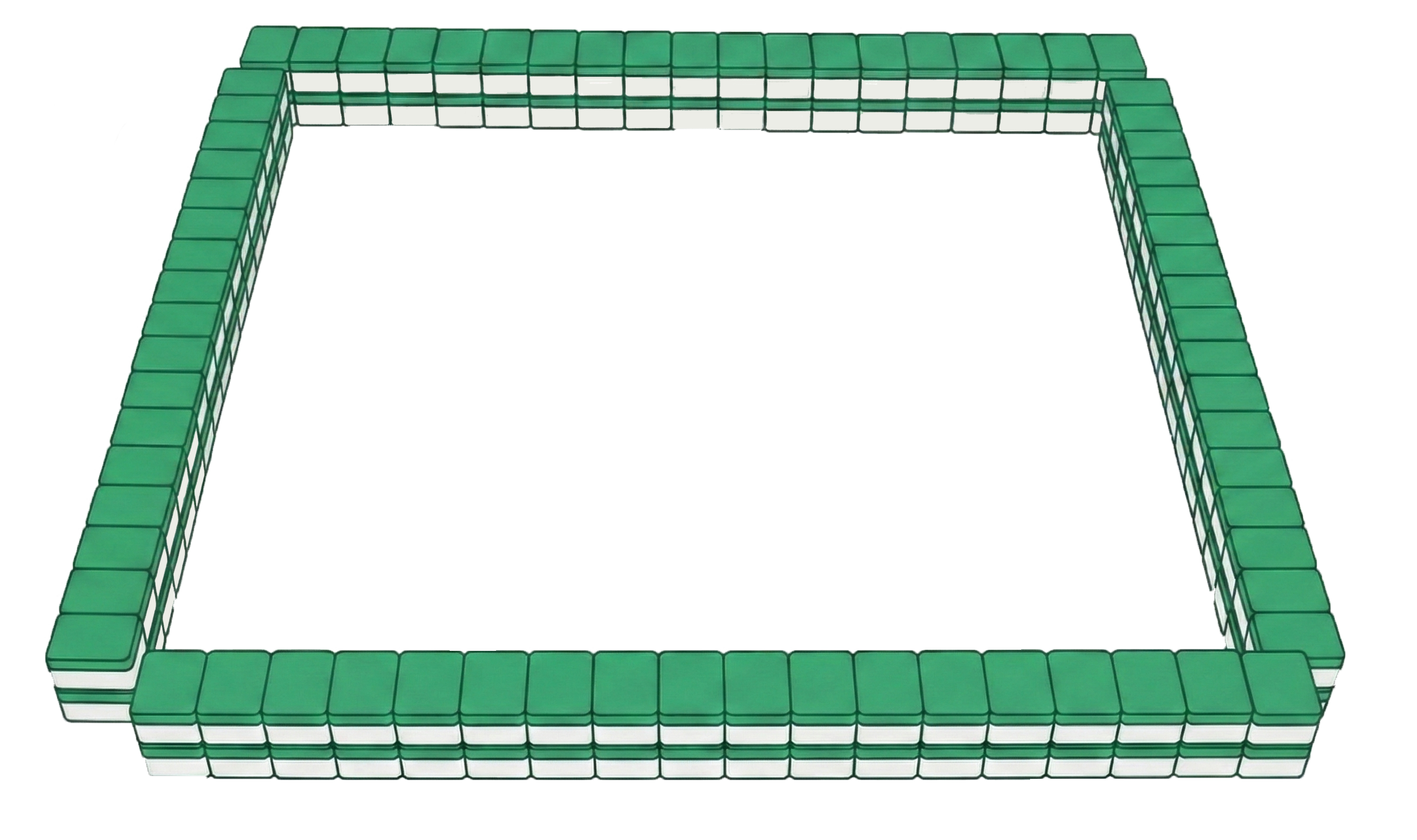
All 144 tiles are shuffled. Each player builds a row of face-down tiles in front of them, two tiles tall, forming four walls around a hollow center.
Determining the Dealer
At the start of a new game, each player rolls two dice. The highest roller rolls again. Starting with that player as one, count counter-clockwise based on the result of the roll. The player the count lands on becomes the dealer (mano).
In subsequent rounds, the winner of the previous round becomes the dealer (mano).
Break the Wall
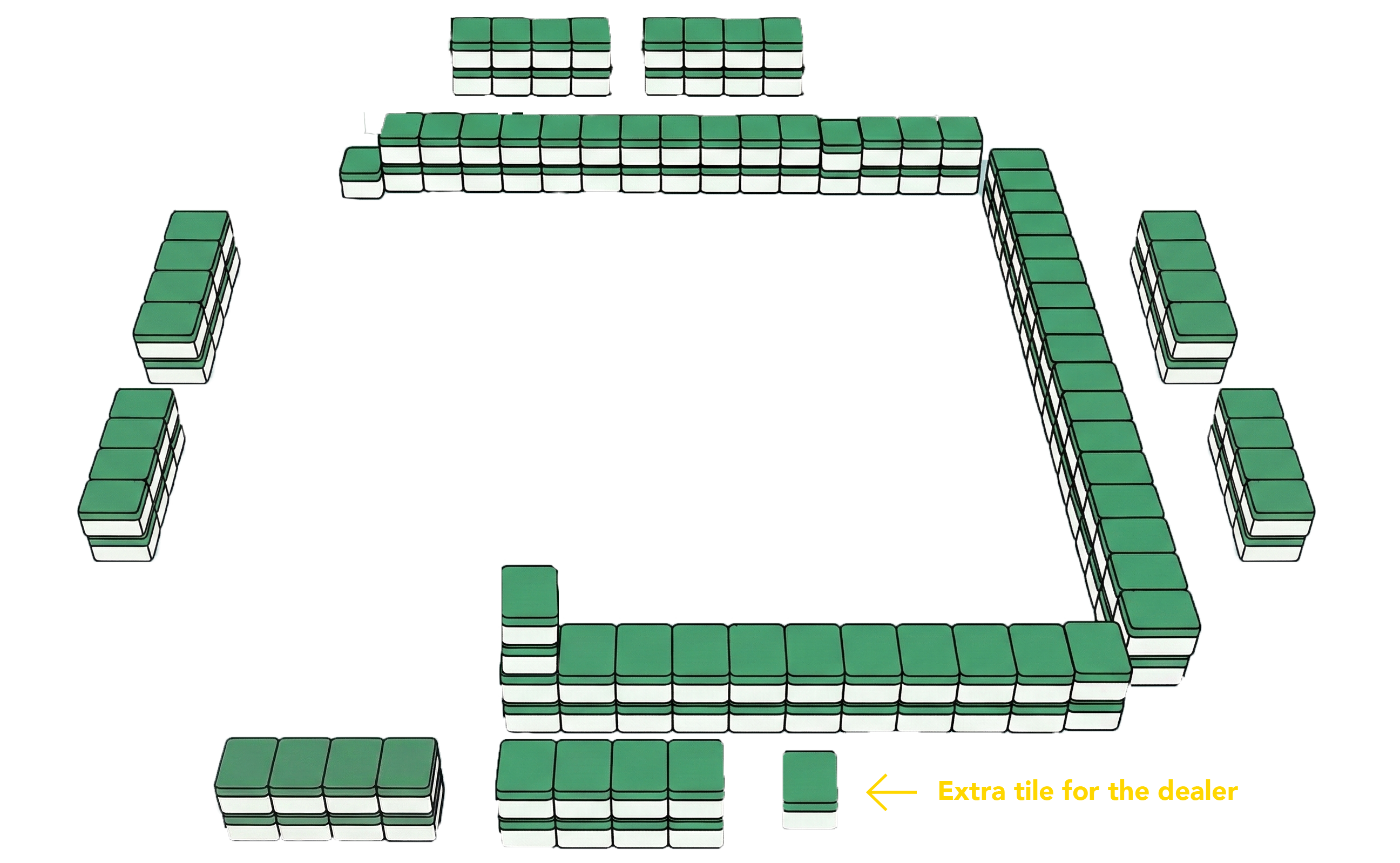
The dealer chooses any wall except their own. Starting from either end of that wall, they count along the wall according to the number rolled. The tile reached (both the top and bottom tile) is removed and placed on top of an adjacent stack, splitting the wall into the bonus wall and the draw wall.
Note: Always keep one or two tiles on top of the bonus wall to distinguish it from the other draw wall.
Deal
Starting at the break on the non-flower side, each player draws four stacks of two tiles (8 tiles), beginning with the dealer and proceeding counter-clockwise. This process is repeated once so that each player has 16 tiles.
After the second pass, the dealer draws one additional tile from the non-flower side, giving them 17 tiles to start, while all other players remain at 16 tiles.
Players stand their tiles on edge in front of them so they can see their own tiles while keeping them hidden from other players.
Note: It is considered good practice for the player seated at that side of the wall to help pass out the tiles during the deal.
Replace Bonus (Flower) Tiles
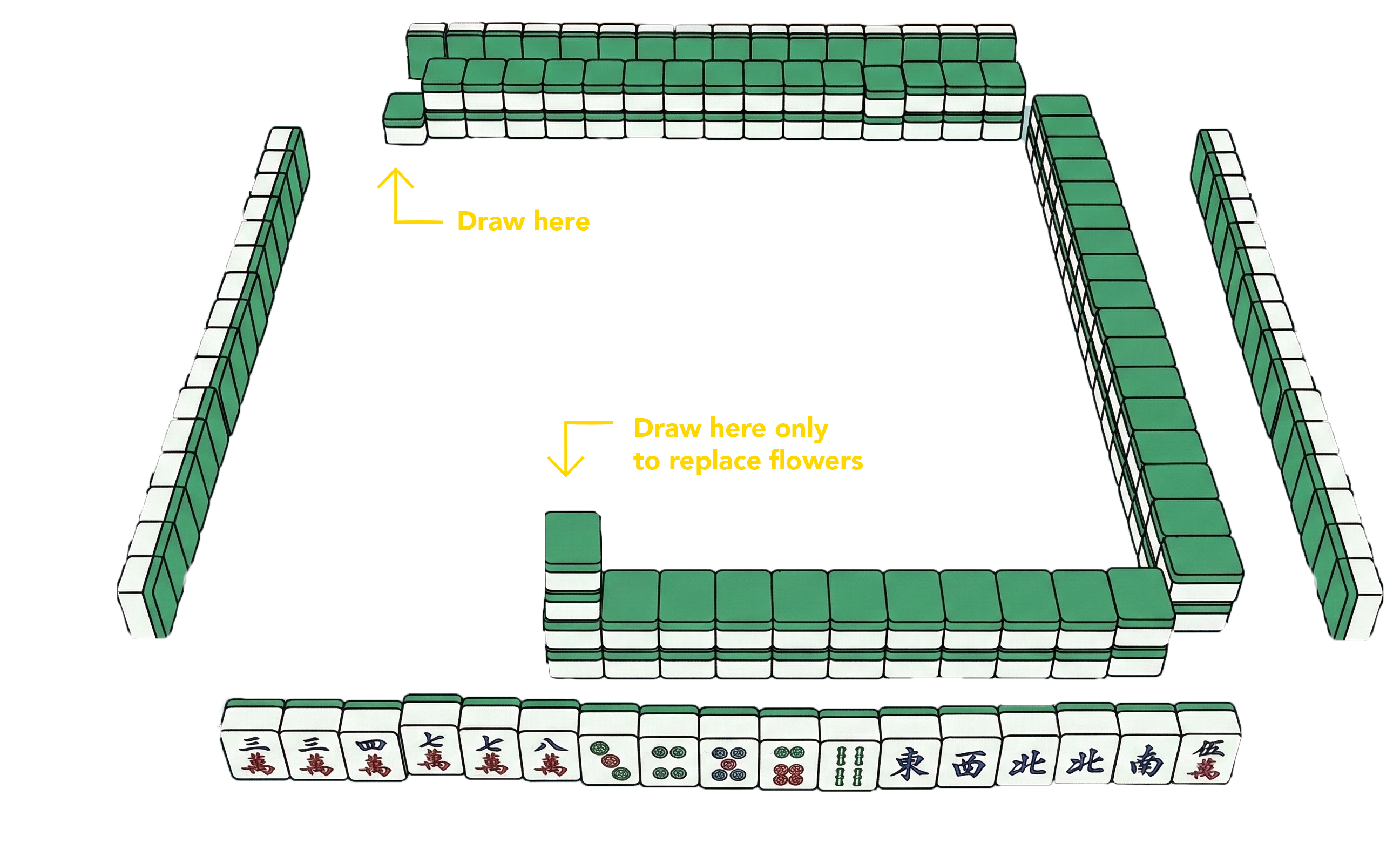
Each player sets aside any bonus tiles from their hand. The dealer draws replacements from the bonus wall first, then goes counter-clockwise to the next player. If a replacement is itself a flower, draw again from the non-bonus wall on your turn. This continues until all hands are free of bonus tiles.
Note: bonuses are placed face-up.
Organize & Play
Players may arrange their tiles in any order, though many sort them by suit and number to help identify sequences and pairs. The dealer begins play by discarding one tile face-up in the center of the table.
Gameplay
The dealer (mano, who has 17 tiles) discards the first tile to begin play.
The round continues counter-clockwise. On each turn, a player draws one tile, either from the draw wall or by claiming the last discarded tile from the center. They then discard one tile to keep their hand at 16 tiles. The goal is to work towards a winning hand of five melds plus one pair.
Note: As a courtesy, players should clearly name their discard when placing it on the table. Discards should be placed face-up in the center, where all players can see them.
Claiming Scenarios
- If a player claims a tile from the center of the table, they must reveal the completed meld face-up in front of them and then discard one tile. Play continues counter-clockwise.
- If no one claims the discard, the next player draws a tile from the draw wall (not the bonus wall) and then discards one tile face-up in the center of the table.
Melds
There are three types of melds: Chow, Pong, and Kang. When a discarded tile completes one of these melds in your hand, you may claim it.
Claiming: Important Notes
- If multiple players wish to claim the same tile, priority applies: Mahjong > Kang or Pong > Chow.
- Only the most recently discarded tile may be claimed. All previous discards are considered dead.
Bonus (Flowers)
If a flower tile is drawn, it is set aside and replaced by drawing from the bonus wall until a non-flower tile is drawn. The player then discards one tile from their hand.
Note: Always keep one or two tiles on top of the bonus wall to mark it as the replacement source.
The game continues counter-clockwise in a draw-and-discard pattern until a player wins or the wall is exhausted, resulting in a draw.
Waiting
You are considered “waiting” when your hand is one tile away from a valid win. In this state, one specific tile or a small set of tiles can complete your hand.
The winning tile can come from your own draw or from a discard you are allowed to claim.
Waiting Variations
Winning
When your final tile completes a legal hand, you win the round and can call out “mahjong!”
Winning Variations
There are special winning variations that result in higher payouts:
Bonus Payout Conditions
Game Variations
Here are some special rules, which are optional to gameplay.
Doubles
If doubles are rolled when breaking the wall, all payouts for that round are doubled.
Jai Alái (Pot)
Each player puts a share (typically $1) into the jai alái (pronounced hai-a-lai). The round winner earns one marker; a búnot win earns two. The first player to collect five markers wins the pot.
Adding Jokers
After all flowers are replaced, the máno rolls the dice and counts that many tiles down the flower wall. The top tile is flipped. If it's a flower, keep flipping until a suited tile appears. That tile becomes the joker and can represent any other suited tile.